
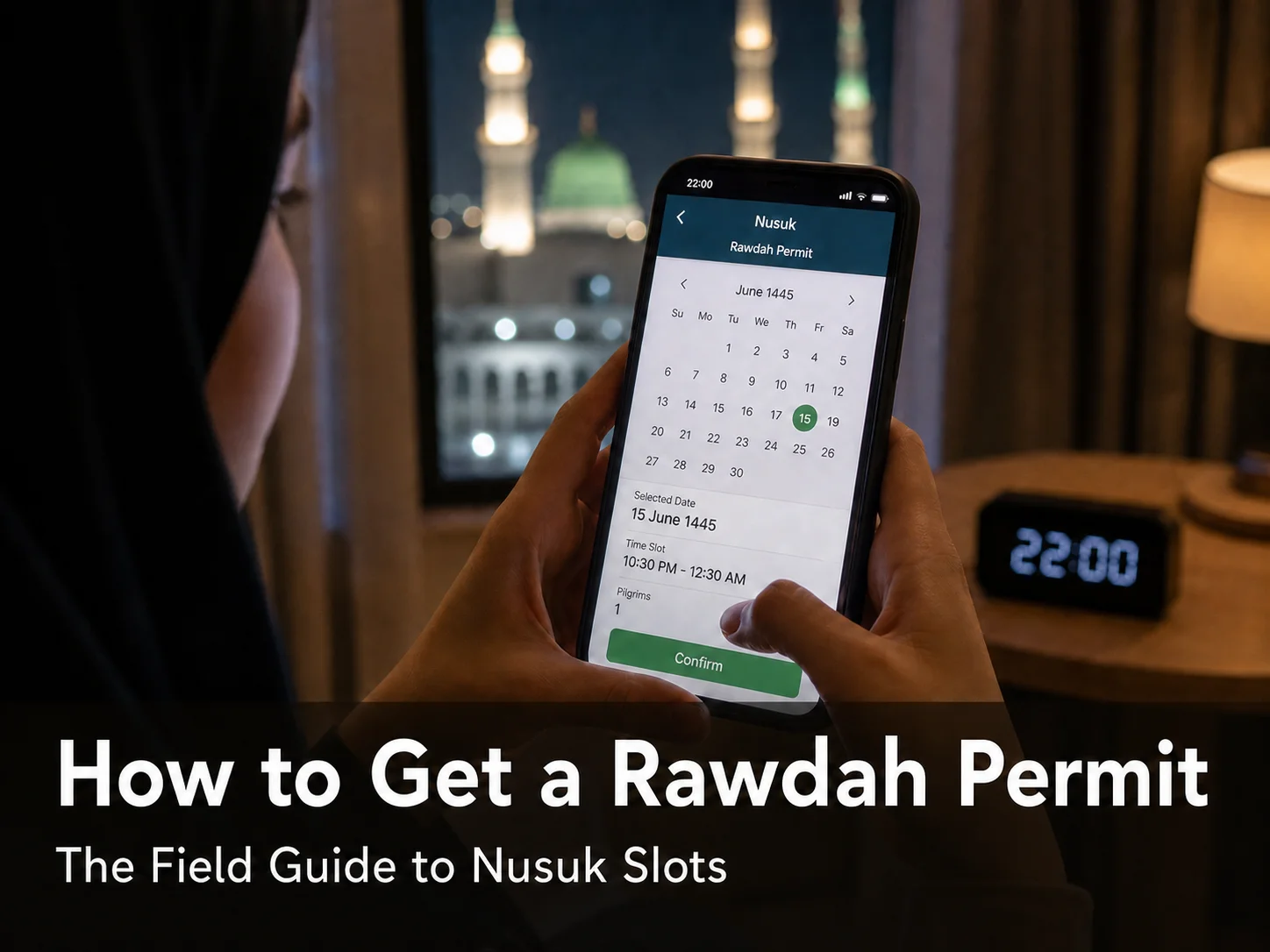
A woman lands in Madinah. Her husband already has his Rawdah permit. He booked it from home, three weeks before they flew.
She has been opening the Nusuk app every twenty minutes for eleven days. At exactly 22:00 Saudi time, the calendar turns green. She taps the slot, then taps confirm.
“Not enough capacity.”
The slot is still on her screen. It just isn’t hers.
She walks to the help desk near the masjid. In her words, the staff were “completely useless.” They were confused too, she says, about why slots were not appearing every twenty minutes.
She also knows people who paid a fee to secure a spot. She is hoping she will not have to.
This is not a rare story. It is the typical story. We surveyed the 17 families who went to Umrah from UK with us last month. Eleven of them were struggling to get a permit, and at least seven of those eleven were women, or men and daughters trying to book for women in their families: a mother, an aunt, a wife, a grandmother.
Most guides start with app screenshots and instructions. They skip the part that matters most: what happens when the slot you finally see disappears before you can claim it.
The Rawdah permit is not a booking. It is a contest. There are roughly 50,000 permits a day and a world full of people who want one. You will not win it by reading instructions. You will win it by knowing three things: when the system releases slots, which of four channels is least crowded, and what to do in the twelve seconds after a slot appears. Everything below is about those three things.
What the Rawdah Permit Actually Is
First, one correction that ends more arguments than anything else in this guide. Pilgrims use three names for what they think is one place. It is not one place.
| Name | What it physically is | Permit? | Who can go |
| Ar-Rawdah (Riyad ul-Jannah) | The carpeted area between the Prophet’s ﷺ house (now his grave) and his minbar, marked by its own pillars and a different carpet colour | Yes. This is what Nusuk books | Men and women, in separate time windows |
| The Salaam walkway (courtyard) | The path that runs past the grille of the Prophet’s ﷺ grave | No | Men via Gate 1 (Bab as-Salam). Women via Gates 21, 22 and 32 after Fajr and after Isha |
| The grave chamber itself | The area behind the grille | No one “books” this | Men walk past it. Women give salaam from behind a white curtain |
Why this matters: when a woman reads “women can’t go to the Rawdah,” that person is usually describing the salaam walkway, not Riyad ul-Jannah. Women do pray inside Riyad ul-Jannah. With a permit, at Gate 37, in their own windows. When a man reads “you can walk past without a permit,” he is describing the salaam route, which does not let him pray there.
Both rules come from the same hadith: “What is between my house and my pulpit is a garden from the gardens of Paradise, and my pulpit is upon my fountain (Hawd).” (Sahih al-Bukhari 1196; also in Sahih Muslim 1391.)
One more fact that surprises people. The Umrah permit is not being checked at all. The Rawdah permit is checked, scanned and enforced at several checkpoints. Do not carry a relaxed assumption from one to the other.
Why It is So HARD
Saudi authorities have said the Noble Rawdah receives around 50,000 visitors a day across four entry periods: two for men and two for women. That works out to roughly 12,500 visitors per period, although capacity is not necessarily identical across every window. Entry support is available in 11 languages, with dedicated lanes for elderly visitors and people of determination.
The numbers from 2024 show just how much demand the system handles. More than 10 million people visited the Rawdah that year. The official figures were 5,583,885 men and 4,726,247 women, according to the authority responsible for the Prophet’s Mosque.
Now do the division with us. If 50,000 visitors are spread across four periods, that is about 12,500 places per period. Men and women do not simply divide those places evenly. Their visiting windows are different, with women’s periods scheduled after Fajr and after Isha, while men have access across more of the day.
And there is another complication. Pilgrims discussing the booking system online describe competition from group bookings, travel agencies, residents of Madinah and the Gulf, repeat users of Instant Track, and people they believe are reselling permits. These reports do not establish how many permits are allocated to each category, but they help explain why the number of places visible to an individual pilgrim can feel much smaller than the headline daily capacity suggests.
Then comes the part most guides miss: the release moment is not necessarily the quietest moment. It is the moment of the most competition.
Pilgrims have reported seeing useful booking windows disappear within seconds. One pilgrim measured the useful window at about 40 seconds. Another said slots went in 20 seconds. A third saw a slot at 12:01 and it was gone at 12:02.
These are individual reports, not an official measure of booking speed. But they point to the same practical problem: seeing a slot does not mean you have secured it.
That is why “just keep checking the app” is not much of a strategy on its own. You are competing for limited capacity with other people checking at the same time.
The better approach is to widen your chances: understand the release pattern, watch more than one available booking route, and be ready to act immediately when an opening appears.
That is what the rest of this guide focuses on.
The Four Booking Channels
Almost every failed booking story we heard had the same problem: the pilgrim knew about only one way to book.
There are actually four channels. They are listed here by how well they work in practice, not by which one is officially promoted.
Channel 1: Nusuk mobile app
This is the standard route. It is official, free, and linked to your passport.
The useful thing to know is when new slots tend to appear. Pilgrims have reported seeing them at :00 and :30, while others caught them at :01 and :31. People who watched the clock down to the second have reported slots appearing at around :01:45 and :31:45.
If your travel date is fixed and you are still at home, this is usually the easiest place to start. One pilgrim in Canada managed to book appointments for herself, her husband, and her son 25 days in advance.
The frustrating part comes after you find the slot.
You select it, continue, and then the system may fail at confirmation. During busy periods, this is where many pilgrims run into the dreaded “Not enough capacity” message. Seeing an available slot does not always mean the booking will go through.
Channel 2: Nusuk web portal
This is the one most pilgrims seem to overlook.
You can log in through services.nusuk.sa, using the same Nusuk account details. And there is a good reason to try it when the app keeps telling you everything is full.
Some pilgrims have reported the website showing availability when the app showed nothing. One described trying the app for a month, finding it fully booked, then opening the website and finding several slots available. They booked through the site and completed their visit.
Another pilgrim had a different problem. The mobile app stopped responding after they selected a date, so they switched to a laptop, logged into the website with the same details, and booked the appointment there.
There is another reason to keep the website in mind, especially if you use Android. Some pilgrims have reported the app crashing at the date-selection stage. A workaround that has worked for some people is to create and register the Nusuk account through the web portal on a laptop first, then use those same login details in the app.
The website is not particularly fast or convenient. But that may actually be part of its advantage. Fewer people are competing for slots through it, so when the app looks completely blocked, the portal is worth checking before you assume there is no availability.
Channel 3: Tawakkalna
The Manasik Gate service in Tawakkalna is worth trying because many pilgrims say it is easier to find a slot there than on Nusuk. Once you book, the appointment is sent back into Nusuk.
The main headache is registration. Tawakkalna usually wants a Saudi mobile number for the OTP, so some pilgrims have bought a local SIM near the Haram just to get through sign-up. Two people have reported getting it to work with a non-Saudi number, so it is worth trying yours first.
There are two other things to know. Tawakkalna usually only shows appointments a few days ahead, and the QR code appears about 6 hours before your appointment, rather than 2 hours.
And don’t rely on a screenshot of the QR. One pilgrim found that the code disappeared when they screenshotted it. Show the live QR on your phone instead.
One useful trick came from another pilgrim who noticed Tawakkalna went down about a minute before a large batch of Nusuk slots opened. So if Tawakkalna suddenly stops working, don’t assume you have missed your chance. Check Nusuk immediately.
Channel 4: Nusuk help desk
There are help desks in and around Masjid Nabawi, current locations are outside Gate 4, in front of Gate 316, and at a service centre near Gate 37.
Some pilgrims say staff helped them get permits for groups of five or six. Others found the staff just as unsure about the system as they were.
For women, especially during busy periods, don’t count on the desk to produce a Rawdah appointment if you don’t already have a Nusuk booking.
Think of the help desk as a last resort and a source of live information. Staff can sometimes tell you what is happening on the ground that day. Just don’t build your whole plan around getting a permit there.
And then there’s buying a permit
You may hear about people selling permits for 10 to 25 riyals per person, sometimes selling dozens of permits tied to a single slot.
Those reports are not new, but the practice is still being reported.
We won’t suggest you use that route. It creates its own risks and problems, and there are legitimate ways to keep trying when the normal channels fail.
| Channel | How far ahead | Cost | How crowded | Our pilgrims’ success rate |
| Nusuk app | About 1 to 25 days (it changes) | Free | Very high | 57 |
| Nusuk web portal | Same slots, different queue | Free | Low | 31 |
| Tawakkalna (Manasik Gate) | A few days | Free | Medium | 9 |
| Help desk at Masjid Nabawi | Same day | Free | Low, but unreliable | 3 |
The Slot Clock, in UK Time
This is the section people screenshot. Here is what the field reports say, in Saudi time (AST, UTC+3) with UK time alongside.
Saudi Arabia stays on the same time all year. The UK doesn’t. From the last Sunday of March to the last Sunday of October, the UK is on BST, which is 2 hours behind Saudi time. For the rest of the year, the UK uses GMT, which is 3 hours behind Saudi time.
If you are travelling in August, see our August Umrah packages to compare the available package options for that month.
The three products, three rhythms
Here’s the pattern that changes how you use the app.
Within each half-hour, Nusuk appears to offer three different types of availability at different offsets. The timings overlap, which is why watching only the exact hour and half-hour can make you miss a slot.
Think of each 30-minute cycle like this:
:00 to :01
Regular slots can appear, and Instant Track may also release same-day appointments.
:15
The waiting list opens.
:20
Another Instant Track release may appear.
:27 to :31
A key hunting window around the next regular release. Pilgrims reported finding slots during these minutes, not just exactly at :30.
:30
Another regular slot release.
:40
Another Instant Track release.
:45
The waiting list opens again.
:57 to :01
Another hunting window around the next :00 release.
There is one timing detail that can change how you approach it. At around 22:00 Saudi time, a large batch reportedly opens. When that happens, don’t spend too long comparing appointment times. Click through quickly and take an available slot.
The clock, converted for the UK
| Saudi (AST) | UK summer (BST) | UK winter (GMT) | What happens |
| 12:00-15:00 | 10:00-13:00 | 09:00-12:00 | Men’s pre-booked slots show up here most often |
| Friday 14:00 | Friday 12:00 | Friday 11:00 | The men’s weekly batch, after Jumu’ah. It opens the following week |
| Friday 15:00 | Friday 13:00 | Friday 12:00 | The women’s weekly batch, about 1 hour after the men’s |
| 19:00-21:00 | 17:00-19:00 | 16:00-18:00 | Women’s Instant Track after Isha. Very busy |
| 22:00 | 20:00 | 19:00 | The big batch. The best single minute of the day |
| 01:00 | 23:00 the previous evening | 22:00 the previous evening | Men’s Instant Track. Also the 01:01-01:05 and 02:01-02:05 pattern |
| 04:00-05:30 | 02:00-03:30 | 01:00-02:30 | Pre-Fajr releases. Also the monthly batch window, reported on Thursdays and Fridays |
The single most productive minute of the Saudi day is 22:00 AST. In the UK that is 8pm in summer and 7pm in winter. That is not a time to fight sleep. That is dinner time. You do not lose this window to tiredness. You lose it because nobody told you it exists. Most people say “check after Isha.” Isha in Madinah moves with the seasons, around 19:00 Saudi time in winter and 20:30 in summer. The big batch is always at 22:00. Do not follow the prayer. Follow the clock.
Set these alarms:
- Every day: 19:58 in summer, 18:58 in winter. (The 22:00 batch.)
- Friday: 11:58 in summer, 10:58 in winter. (The men’s batch.)
- Friday: 12:58 in summer, 11:58 in winter. (The women’s batch.)
The 12-Step Booking Protocol
Before you leave the UK
Step 1: Register the moment your visa number exists. If you still need an Umrah visa, contact us before you begin the Nusuk registration process. Nusuk asks for your visa reference number and passport details. Register as an “International Visitor” with your passport number, date of birth and email. You do not need a Saudi mobile number. The OTP goes to your email.
Step 2: One account per person. No exceptions. This is the most common failure in family groups. Every adult needs their own Nusuk account and their own phone at the gate. Children over about 10 need their own permit on their own passport. Younger children can enter with a parent who holds a permit, one child per adult, but the rule is applied unevenly, so book for them if you can. Use the “Add a Friend” feature to link family members and hold the same slot.
Step 3: Before you start hunting for slots, look at the gender field yourself. Don’t assume it is correct. One pilgrim’s warning sums up the problem:
“Absolutely make sure of the gender in the app, especially for women, before applying.”
They described Nusuk’s gender setup as confusing and warned that getting it changed can mean a lot of time and frustration. A wrong gender field puts you in the wrong pool. You will never see the slots your family sees.
Step 4: Fix your phone’s clock before you book (iPhone users, this is for you). There is a known bug. When your phone’s time zone is not Saudi, the app can show a date one day off. It used to fix itself on arrival in the Kingdom. Pilgrims report it no longer does. Assume the date you see after booking is the date you get. Fix A (best): book on the web portal, not the app. Fix B: in Settings, under General and Date and Time, turn off Set Automatically, set the time zone to Makkah, book, then turn it back on. Fix C: if the app shows the day before your target date, pick one day after your target. Then check the confirmation date against your flight and hotel dates.
Step 5: Use the strongest network you have. UK data on roaming, inside a marble building full of people, is a real failure variable. Use hotel Wi-Fi, or buy a Saudi SIM (STC, Mobily or Zain, about 50 to 100 riyals with data) at the airport. You will need live data at the gate anyway.
The Hunt
Step 6: Don’t automatically use the channel you know best. Use the one with fewer people fighting for the same slots.
If you are still in the UK, keep the Nusuk app and web portal open at the same time, ideally on two devices. If you are already in Madinah, focus on Instant Track and be ready for the 22:00 Saudi-time batch.
Step 7: Get into position 60 to 90 seconds early. Have your name already selected and stay on the calendar screen. Don’t sit on the home page waiting for the clock to change.
One pilgrim described the method simply:
“Stay on the page that has your name. As soon as it changes to 12:00, check dates and times. If nothing, go back and repeat for about one minute.”
That extra minute matters. Don’t refresh once and give up.
Step 8: Do not close the app. Do not go to the home screen. The loop that works: pick the date, pick the slot, pick the time, confirm. If it fails, press Back only, then pick the date again. Going to the home screen and walking back in costs 5 to 8 seconds. Those are the seconds that decide it.
Step 9: Take the first slot that works. Optimise later. “Do not waste time thinking about a suitable slot.” A permit you can cancel beats a perfect slot you lost. You can cancel before your appointment time, and people do it again and again without penalty, as far as the reports go. What you must not do is let a slot pass unused.
Step 10: Work the failure ladder, not the retry loop. When confirm fails, do not just tap again. Go back one screen and re-select the date (the 8-second reset). Toggle Hijri and Gregorian 3 to 7 times. Close the app fully and reopen it. Switch to the web portal. Switch device, or switch from mobile data to Wi-Fi. Delete the app, reinstall it and log in again. One pilgrim failed for three days straight, then fixed it with a fresh account, a correct name, and a clean reinstall.
After You Get It
Step 11: Understand the confirmation window, or you will lose a permit you already hold. Your booking may say “Awaiting Confirmation” with a countdown. That is normal. Your slot is held. The confirm button is disabled on purpose until the window opens. The window opens about 48 hours before your appointment and closes about 2 hours before. Confirm inside it, or the appointment can be cancelled. The QR appears about 2 hours before your slot on Nusuk, and about 6 hours before on Tawakkalna. You can reschedule up to about 6 hours before. And here is the big one: if your slot passes unused, your passport is reported to be locked out for 365 days. That is the most expensive mistake in the whole process.
Step 12: Prepare for the gate. Screenshot the QR code, and carry live data too. Reports disagree on screenshots. Some gates accepted them, some did not, and one pilgrim was told directly that screenshots would not do. So carry both. Turn your screen brightness to the maximum for the scanner.
7. Instant Track: The Geofenced Second Chance
Instant Track (also called Fast Track, or al-masar al-fouri) rescues most of the people who arrive in Madinah empty-handed. It is also the channel with the most misunderstood rules. Here are the five rules, as reported by people who used it successfully.
Rule 1: You must be near the masjid. Location services must be ON for the Nusuk app. It is a geofence.
“Instant Track only works if you are near the Rawdah. If you are even on the other side of Masjid Nabawi, it’ll say you are too far.”
Another pilgrim’s rule of thumb: be around Gate 32. If your hotel is a few hundred metres away, it usually works from your room.
Rule 2: It only shows about 2 hours ahead. Check at 13:00 and you will see slots until 15:00. Do not book a slot you cannot physically reach.
Rule 3: It releases about every 20 minutes. At :00, :20 and :40.
Rule 4: The rules around it keep changing. In the past, Instant Track only unlocked after a pre-booked visit. Recent reports say this has relaxed. Instant Track now allows repeat visits within the year, without waiting the full 365 days. That is why the standard permit is once a year and Instant Track is not. Do not assume either rule. Test it on your own account.
Rule 5: It is the most time-sensitive thing in this guide. “Slots open every 20 to 30 minutes and are booked within 20 seconds.”
The best windows, as reported. For men: around 01:00 Saudi time (11pm the previous evening in the UK), and 13:00 to 15:00 Saudi time (11am to 1pm in the UK in summer). One pilgrim found slots between Zuhr and Asr. For women: after Isha through midnight is the busiest and the least useful window. The pilgrim who tried it again and again advises going later. “The later you try, the less busy it is.” Also try after Fajr, and in the early hours.
Booking for Someone Else
A big part of the frustration isn’t “I can’t get my permit.” It’s “I can’t get my mother’s permit.”
The defining case: a pilgrim in Madinah, refreshing the app every twenty minutes for his aunt, who has no smartphone that can run Nusuk, with five days left. He reaches the confirm screen and gets a failure. Other times the appointment window disappears completely.
Booking for someone who doesn’t have a phone
The practical workaround is to create the Nusuk account in their name, using their passport details. Registration requires the passport number, date of birth, visa number and email address. Since the OTP goes to the email, you can manage the account from your own inbox.
But there is one thing families often discover too late: they still need a device at the gate.
It can be an old Android phone with Nusuk already installed and logged in, a tablet, or even your own phone with their account open when they reach the checkpoint.
Test the login before you travel. You don’t want to discover at the gate that the account has logged out or needs another verification step.
If the companion feature fails
Don’t spend hours fighting the companion function. Book family members one at a time.
One mother registered her two daughters, aged 7 and 9, by signing out of Nusuk and then signing back in under each child’s account. It took longer, but it worked. Her experience also suggested that the actual slot window can last longer than the often-mentioned 40 seconds.
For groups, agents used to book one appointment for a whole group. A Nusuk system upgrade broke group booking. If your agent promises group Rawdah permits, ask to see the mechanism. Some pilgrims report that visa-issuing companies near the Rawdah entrance can book for a group from their own system. That sits in a grey zone. Check before you rely on it, and never pay for a “guaranteed” permit.
Accessibility lanes exist. There is a dedicated path for the elderly and people of determination, and a wheelchair line at the Rawdah, one carer per wheelchair. But do not expect leniency on timing.
The Error Dictionary
Keep this. It is the section that saves trips.
| What the app says | What it means | What to do |
| “Not enough capacity” after you tap confirm | You lost the race. The slot was taken between the moment it showed and the moment you confirmed. Error code 10005000 is reported with it. Not a bug in your account | Do not retry the same slot. Press back, pick the date again, take the next available slot. Then work the failure ladder |
| The slot appears, then the window disappears | The slots were pulled mid-transaction, usually a batch being re-held | Wait 20 minutes for the next cycle. Do not tap fast |
| “Awaiting Confirmation” with a countdown, button greyed out | Your slot is safe. The window opens about 48 hours before and closes about 2 hours before | Set two alarms: one at T-48 hours, one at T-3 hours. Confirm inside the window |
| “56 minutes left to confirm” but the button is off | Same mechanism, later in the window | Confirm at once. If it stays off, try the web portal |
| “Rawdah issuance has been stopped since a specific date” | A seasonal or operational stop. This happens around Hajj season and in the pre-Hajj window | Check with your agent. Do not buy a permit from anyone who says they can override a stop |
| Blank screen, grey calendar, no dates | Almost always “not released yet,” not “sold out” | Keep the daily rhythm. Check the web portal to be sure |
| The app crashes at the date step (Android) | A known app bug | Register on the web portal (services.nusuk.sa) from a laptop, then log into the app with the same details |
| “You are too far,” or the Instant Track icon is grey | You are outside the geofence | Move to the Gate 32 side. Turn on precise location for Nusuk |
| The wrong date on your confirmation | The iPhone time zone bug | Fixes A, B and C in Step 4. Assume the date shown is the real one |
| No QR code after confirming | Normal. It appears about 2 hours before (about 6 hours on Tawakkalna) | Wait. Keep data on. Screenshot it the moment it shows |
| “You cannot book. Previous permit within 365 days” | The yearly lock, tied to your passport, not your visa. A new visa does not reset it | Instant Track near the masjid is the reported route to a repeat visit inside the year |
| Name mismatch at the gate, or the permit belongs to someone else | Permits are tied to the passport. They cannot be transferred | Do not try. |
What We Do for Our Pilgrims
Not “we guarantee your Rawdah permit.” Nobody can. Anyone who says so is either lying or selling you someone else’s slot. Here is what an operator can properly do, and what we do for you from our UK office:
We set up every traveller’s Nusuk profile before you fly. The elderly parents and the children without phones are included. We check the gender field and the passport match on each one. We have watched too many families discover this at Gate 37. We run a monitored slot watch across the 22:00 Saudi window (8pm UK in summer, 7pm in winter) and the Friday post-Jumu’ah windows, for the whole of your stay in Madinah, on the app, the web portal and Tawakkalna at the same time. We walk your group through the cancellation rules, so nobody loses a year to a missed slot.
How This Guide Was Built, and Why to Trust It
We compiled seventeen surveys from our past clients and pilgrim discussion threads from r/Umrah, plus supporting reports from r/saudiarabia and r/islam. That covered about 120 first-hand experiences from pilgrims who travelled between 2022 and this season. We cross-checked the official figures from the Saudi Ministry of Hajj and Umrah, and from the authority for the care of the Prophet’s Mosque.
If you are planning Umrah from the UK and want help with the wider arrangements, you can explore our Umrah packages or speak to our team before you travel.
